 Snagga
Speed on site
If it's slower than a notebook, it's failed. Every interaction is built for one hand, gloves on, in the rain.
Snagging isn't difficult work. It goes wrong the same handful of ways on nearly every job — and almost none of it is about the snagging. It's about everything that happens to the information afterwards.
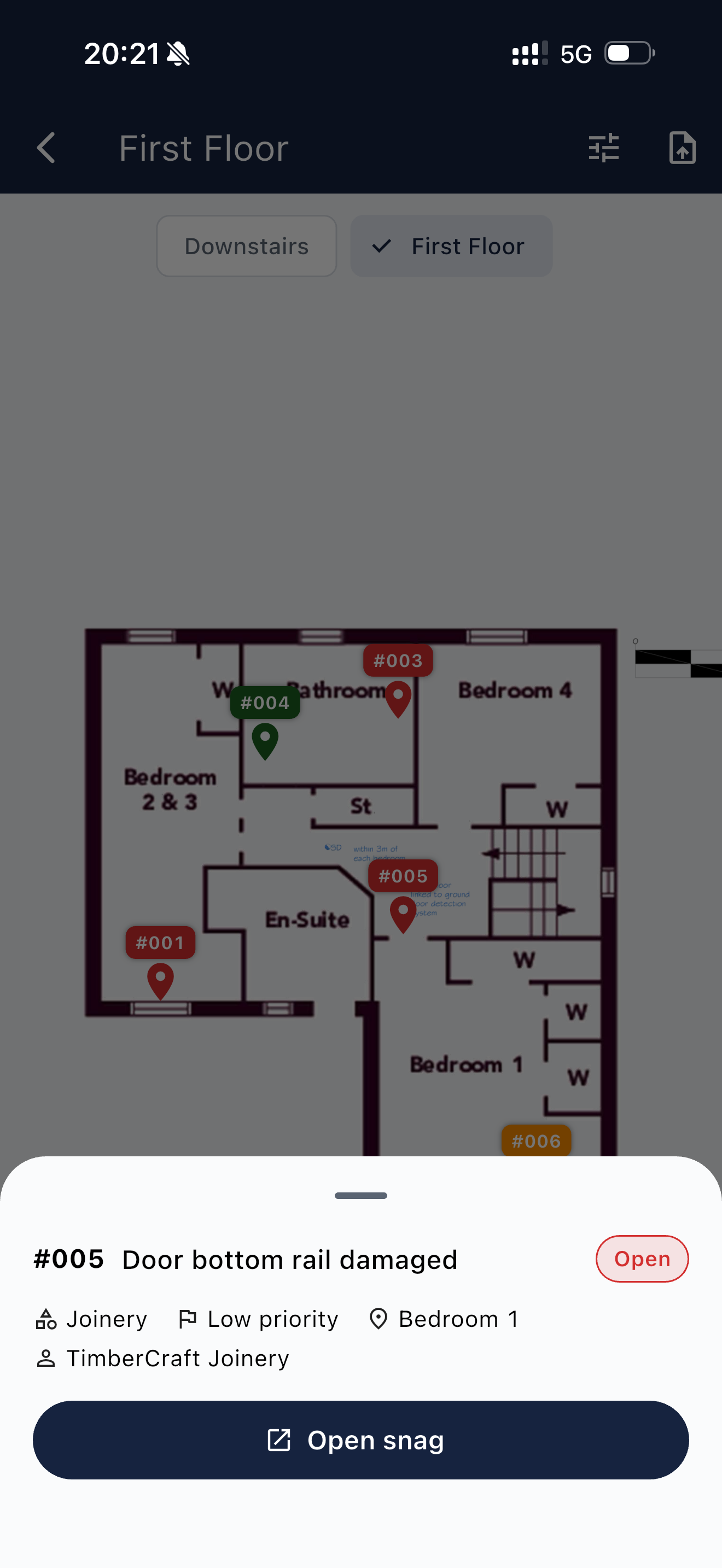
Every defect pinned to the drawing, with its photo, markup, note and status on the same item. Tap a pin to open the snag — trade, priority, location and status right there, then straight into the full record.
I found that too much of my week went on chasing snags rather than closing them — the list in three notebooks and a soaked drawing, the evening lost to the write-up, a spreadsheet nobody trusted, and the proof buried in an email chain.
None of that was anybody's fault. There just wasn't a sensible place to put it.
So I built what I'd wanted: one place for the list, with the location, photo, markup and note on the same item; priorities, so the things that held up the job went first; checklists, so nobody had to ring the office; and — the part that mattered most — free for the people doing the work, so they could mark a job done and send the evidence with it.
That's still what it's for.
If it's slower than a notebook, it's failed. Every interaction is built for one hand, gloves on, in the rain.
No feature for feature's sake. We say no to complexity so the trades actually adopt it.
Time-stamped, attributed, defensible. Your quality record should hold up when it matters.
Site managers running the close-out. Contractors handing over. Snagging and pre-completion inspectors reporting for a client. Trades receiving work and proving it's done. Anyone who has ever written the same defect down twice.
Whether you're snagging a single plot or a whole estate, we'd love to have you on board. Questions, or something you'd want it to do? We read everything.